From Primary 3 to Primary 4: The Year That Starts to Count
Primary 4 is where the Singapore primary school year stops being practice. The work gets more abstract, the marks start accumulating from Term 1, and the examination at the end of it shapes what your child studies for the next two years.
1. What Changes in the Work
Primary 3 already introduced the shape of upper primary: Science appears as a subject, weighted assessments begin, and the reading load rises. Primary 4 does not introduce a new shape. It takes the same shape and makes it abstract.
Maths moves away from things you can count
Lower primary maths can mostly be pictured, drawn, or acted out. Primary 4 asks children to work with fractions as quantities rather than slices of pizza, with decimals, with area and perimeter as formulas rather than squares on a grid, and with angles. The child who has been quietly coping by visualising everything runs out of pictures.
Questions start combining topics
A Primary 2 question tests one thing. A Primary 4 question may need a fraction converted, then a multiplication, then a comparison, and the child has to work out that sequence themselves because nobody names it in the question.
Science asks for explanations, not labels
Primary 3 Science is largely about identifying and classifying. Primary 4 begins asking why, and the answer has to be written in sentences with the right terms in the right order. Children who know the science well can lose most of the marks here because the difficulty is in the writing.
English comprehension stops being findable
In lower primary, the answer is usually somewhere in the passage. From Primary 4 onwards, more questions require inference: what a character felt, why something happened, what the passage implies without saying. There is nothing to locate and copy.
And the reading itself gets longer, everywhere
Not just in English. Maths word problems grow a sentence or two. Science questions arrive wrapped in a scenario the child has never seen. A child who reads slowly now pays that cost in three subjects at once.
None of this is unreasonable. It is what upper primary is for, and most children absorb it over the year. But it does mean that a gap which was manageable in Primary 3 becomes load-bearing in Primary 4, because everything new is built directly on top of it.
2. Why This Year Counts More
Three features of how Primary 4 is assessed combine, and most parents only notice after the fact:
There is no mid-year exam to tell you where you stand. MOE removed mid-year examinations progressively from 2019, beginning with the transition years of Primary 3, Primary 5, Secondary 1 and Secondary 3, and completed the removal across all primary and secondary levels by 2023. This is a good change for most children. But it does mean the first full-scale examination of the Primary 4 year is the one in October, and by then there is no time left to act on what it tells you.
The marks accumulate from Term 1. In place of mid-years, schools use weighted assessments, capped at one per subject per term. These count towards the year's result. There is no longer a structure in which a shaky first half can be written off and recovered after the mid-years, because there are no mid-years and the early marks are already in the ledger.
The end-of-year examination covers the whole year. Without a mid-year exam to close off the first half, the October paper examines everything. For a child with working memory or retrieval difficulties, a single assessment covering twelve months of material is a significantly harder format than two covering six months each.
Then the result does something
At the end of Primary 4, the school recommends a subject combination for Primary 5 based on your child's exam results, and you indicate your preference on an option form. A child who passes three or more subjects is offered four Standard subjects; a child who passes two or fewer chooses from a range down to four Foundation subjects.
Put together: your child's Primary 4 marks accumulate from the first term, are examined in full in a single October paper, and that result shapes what they study for the next two years.
Two facts to keep clearly in mind:
- Foundation level is not a failure, and it is not a dead end. It exists so a child can work on firmer ground and genuinely master the fundamentals, and MOE is explicit that this is its purpose. The subject combination is reviewed again at the end of Primary 5, and a child doing well at Foundation level may move to Standard for Primary 6.
- The Primary 4 year is still the one point where a few marks change the shape of the next two years. That is worth knowing in January rather than in November.
3. Where Children with Developmental Differences Come Unstuck
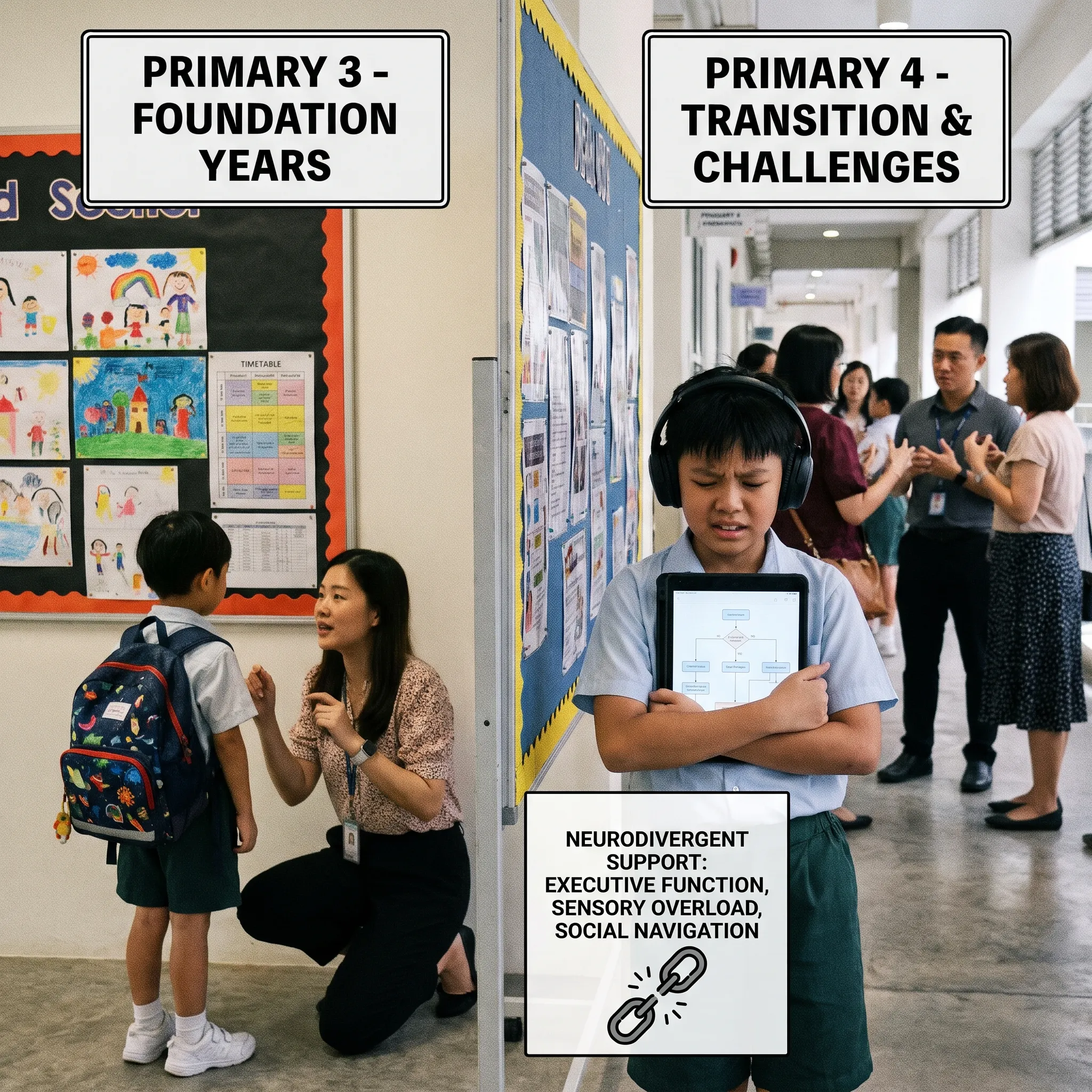
The pattern we see most often in Primary 4 is a child whose results drop without their understanding dropping. Something in the change of format has caught them, and because the result slip only reports marks, it reads as a child who has started to struggle.
| What Changes in Primary 4 | Why It Catches a Particular Child |
|---|---|
| Maths becomes abstract | A child who has been coping by visualising has lost their method, not their ability |
| Questions combine topics | Each step is fine; holding the sequence is the new demand |
| Science wants written explanations | The science is known; organising it into sentences is the obstacle |
| Comprehension needs inference | Answers can no longer be located in the text, which is hardest for literal thinkers |
| Reading load rises in every subject | Slow processing now costs marks in three subjects rather than one |
| Marks count from Term 1 | A slow start can no longer be absorbed, so early difficulty follows the child all year |
| One exam covers the whole year | Retrieval across twelve months of material is a different task from six |
Three profiles, three different ways this plays out
1. Autistic Children
Autistic children often manage the content and struggle with the framing. Inference questions ask what someone felt or implied, which is the kind of reading that is genuinely harder. Science questions set in unfamiliar contexts require transferring a known idea to a new situation. Neither difficulty is about knowing less.
2. Children with ADHD
Children with ADHD are rarely short of understanding. They are short of the sustained attention a longer paper needs and the self-checking that catches an error on the way past. Primary 4 adds length before it adds difficulty, which is the worse order for them.
3. Children with Slower Processing
Children with slower processing face the plainest problem. They know as much and need longer to show it. When the reading load rises across every subject at once, the clock becomes the thing standing between what they know and what they can put down.
Watch Out for the Avoidance Habit
A child who repeatedly loses the thread starts to expect to. They stop attempting long questions, guess quickly to end the discomfort, or leave the last section blank before they have run out of time. By Primary 5, what began as a processing difficulty has an avoidance habit sitting on top of it, and the habit is now the larger of the two problems. That habit is much easier to prevent in Primary 4 than to undo in Primary 6.
4. The Primary 4 Year, Term by Term
Because the marks accumulate, the year has a shape worth planning against rather than reacting to:
| When | What Is Happening | What to Do |
|---|---|---|
| Dec holidays, before P4 | Nothing new is being added, for the last time this cheaply | Firm up the Primary 3 foundations the new work will sit on, particularly number facts and reading fluency |
| Term 1 | New abstract topics arrive; first weighted assessments count | Watch how your child copes with the first fractions and inference questions. This is your early warning |
| Term 2 | The pattern for the year sets | If Term 1 showed a difficulty, act now. This is the last point with enough runway to change trajectory |
| Mid-year holidays | A full break with no exam attached | The best block of the year for revisiting what hasn't stuck, because nothing new arrives on top |
| Term 3 | Content continues; assessments continue | Shift attention to exam conditions: longer sittings, full papers, pacing and timing |
| Term 4 | One examination covering the full year | Revision across twelve months, which is a retrieval problem as much as a content one |
| After the exam | School recommends subject combination; option form | Ask what the recommendation is based on, and what the school has observed all year |
Term 1 is your diagnostic, not your result
The first weighted assessments are small in weight and large in information. A child who struggles with the first fractions topic will struggle with everything built on it. Treat Term 1 marks as a signal to act on.
The mid-year break is the most valuable fortnight
It is the only substantial break where nothing new is being taught and the year is not yet decided. More can be repaired here than in term time when new content keeps landing.
5. What to Do Before Primary 4 Starts
If your child is in Primary 3 now, the December holidays are the cheapest preparation you will get all year, because it is the only stretch where nothing new is being added on top.
Four things worth more than general revision:
- Make the number facts automatic: Times tables and number bonds that are retrieved instantly cost a child nothing. The same facts worked out each time consume exactly the mental space that a multi-step Primary 4 problem needs. Five minutes a day of recall practice, not an hour of worksheets.
- Build reading fluency, in anything: The reading load rises in every subject, so reading speed and comfort pay off three times over. It does not have to be comprehension practice. It can be whatever your child will actually read.
- Teach writing things down: The single most useful habit for the whole of upper primary is externalising: writing the numbers out of a word problem before calculating, numbering the steps, circling intermediate answers. Start it now, while questions are still simple enough that the habit can be formed without content strain.
- Fix one specific gap rather than reviewing everything: If fractions never landed in Primary 3, that is the thing. Primary 4 fractions build directly on it. A broad review of the whole year will feel productive and change nothing.
And two things not to do:
- Do not start Primary 4 content: Pre-teaching next year's topics tends to produce a child who is bored in Term 1 and no better off in Term 3. Depth on the foundations beats a head start on new material.
- Do not spend the whole holiday on it: A child who starts Primary 4 already tired has lost more than they gained. A focused block and then a proper break is the right shape.
6. What to Ask the School, and When
Most parents have one conversation with the school about Primary 4, and it happens in November when the option form arrives. By then the year is over. Three earlier conversations are worth more:
Not how your child is doing, which invites a reassuring answer, but something specific: where in a lesson does my child lose the thread, and what do you do when that happens? Teachers notice a great deal they do not routinely report.
Many mainstream schools have Allied Educators for Learning and Behavioural Support (LBS). Ask what your child receives, what it looks like in practice, and what the school would want to see before offering more.
If your child's difficulty is partly about how they sit a paper rather than what they know, there is a formal route for national examinations, and it starts years earlier than most families realise.
SEAB Access Arrangements
Access Arrangements are extended by the Singapore Examinations and Assessment Board (SEAB) to candidates with special educational needs and medical conditions, and may include extra time, a separate room, enlarged print, or exemption from specific components. Applications are made through the school, not by you directly.
The part that catches families out: An arrangement carries far more weight when it already reflects how your child works. If your child will need extra time at PSLE, the school needs to have been providing and recording it in school-based assessments for some time beforehand. Primary 4 is not too early to ask what would be involved. Primary 6 usually is.
7. How We Work with Children Through This Year
Primary 4 is a year where regular support does more than intensive support, because the difficulty arrives in instalments. New abstract topics land through Term 1 and Term 2, and the useful thing is somebody catching each one as it lands rather than reviewing all of them in June.
Our educators include ex-teachers from Pathlight, St. Andrew's Mission School, and other SPED schools, and ex-Allied Educators from mainstream schools, all with at least two years of teaching experience specifically with children with special needs.
1-to-1 Home Tuition
60 to 90 min weekly sessions. We match the educator to your child by experience with that developmental profile, not only subject.
Small Groups at Centre
Groups of four at Kaleidoscope Therapy Centre on weekends, dedicated to Primary 1 to 3 foundation mastery.
Holiday Programmes
Short, focused blocks during school holidays like our Upper Primary Crash Courses.
We will also tell you honestly when we do not think we are what your child needs. A child whose difficulty is not primarily academic is better served by hearing that from us than by a year of weekly sessions aimed at the wrong thing.
Official Singapore References
- Ministry of Education, Singapore: Removal of Mid-Year Examinations & Assessment Structure
- EduFirst: Weighted Assessments in Primary School: How They Work and What They Count For
- Ministry of Education, Singapore: Subject-Based Banding for Primary School
- Ministry of Education, Singapore: Parliamentary Reply on Streaming in Primary 3 or Primary 4
- Ministry of Education, Singapore: Updates to the PSLE Scoring System
- Singapore Examinations and Assessment Board (SEAB): Access Arrangements FAQs & Applying for Access Arrangements
Disclaimer: This article is general information, not advice about an individual child. Assessment structures, subject-combination rules and application deadlines are revised from time to time, and individual schools set their own assessment weightings. Confirm the current position with your child's school, MOE or SEAB.
