When the Work Gets Heavier: Preparing a Child with Mild Developmental Needs for Primary 5 and 6
For children with mild developmental differences, the move into upper primary is rarely a question of ability. It is a question of load.
How much arrives at once, how fast it moves, and how much of it a child is now expected to manage on their own. This guide covers what changes in Primary 5, how the PSLE actually scores, where difficulties surface, and what strategies genuinely make an impact.
1. What Actually Changes in Primary 5
The content gets harder, but that is the smaller half of the change. The bigger half is that the work stops being broken down for your child.
In lower primary, a question usually asks for one direct thing. By Primary 5, a maths question requires a student to interpret a scenario, determine the mathematical operations required, execute two or three steps in precise sequence, and verify the result against constraints. Each individual calculation may be fully within reach, but holding all of them in working memory under time pressure is the real challenge.
1. Multi-Step Reasoning
Fractions, ratio, percentage, and rate are combined simultaneously in problem sums rather than tested independently.
2. Higher Reading Load
Longer passages across English, Science, and Maths. Slower reading speed now bottlenecks three subjects instead of one.
3. Written Explanations
Open-ended Science requires clear written reasoning using exact keywords. Simply knowing the principle is not enough.
4. Assumed Independence
Fewer instructions repeated or chunked on the whiteboard; increased homework volume expected without parental prompting.
None of this is unusual or unfair. It is what upper primary is designed for. But it does mean that a gap which was manageable in Primary 3 or 4 becomes load-bearing in Primary 5, because everything new is stacked directly on top of it.
The golden rule of upper primary: Old gaps do not stay the same size. They get heavier.
2. What the PSLE Actually Measures
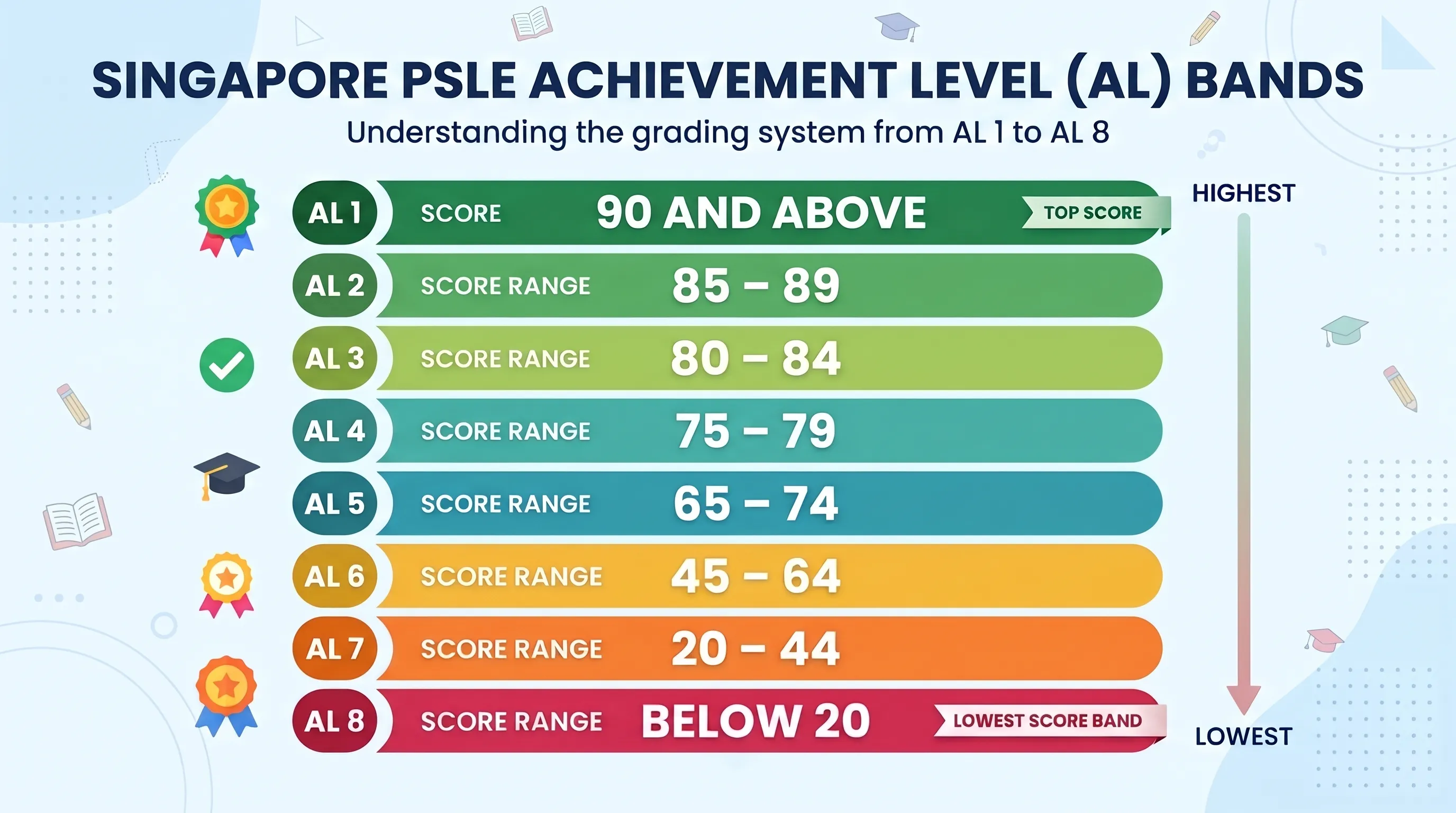
Four subjects, four grades, added together. The Ministry of Education (MOE) scores each subject using 8 Achievement Levels (ALs), and a child's PSLE Score is the sum of the Achievement Levels of their four subjects (English, Maths, Science, and Mother Tongue), ranging from 4 to 32, with 4 being the best total.
| Achievement Level (AL) | Mark Range |
|---|---|
| AL1 | 90 and above |
| AL2 | 85 – 89 |
| AL3 | 80 – 84 |
| AL4 | 75 – 79 |
| AL5 | 65 – 74 |
| AL6 | 45 – 64 |
| AL7 | 20 – 44 |
| AL8 | Below 20 |
The bands are wide, which offers genuine relief: AL5 spans 10 marks (65–74), and AL6 spans 20 marks (45–64). A student having an off morning is not penalized a grade for losing two or three marks. Candidates are scored purely against learning criteria, not a bell curve.
However, the score is a sum: Because the four ALs are added together, a strong Science grade cannot compensate for an English difficulty. When a child struggles with processing speed or reading stamina, that single root issue penalizes them across multiple subjects.
Foundation subjects: Results are reported as AL A, B, or C, which map to Standard AL6, AL7, and AL8 for Secondary 1 posting. Foundation level enables children to build firm confidence, but parents should understand the posting ceiling early.
3. Where the Difficulty Usually Shows Up
The pattern we see most frequently is a student who grasps concepts well during casual revision, yet underperforms in exams. Most often, the breakdown occurs in cognitive execution rather than understanding:
| What a Parent Sees | What Is Often Happening Underneath |
|---|---|
| Knows it at home, blanks in the exam | Working memory is saturated. Timed test retrieval is cognitively distinct from calm recall at home. |
| Gets the method right, answer wrong | An intermediate step was dropped in a multi-step sequence, not misunderstood. |
| Answers the wrong question | The command word was missed or long stem partially read before jumping into working. |
| Leaves the last section blank | Time ran out earlier in the paper—usually eaten up by slow reading rather than slow calculations. |
| Knows science, scores poorly on open-ended | Difficulty translating scientific cause-and-effect into full sentences with required MOE keywords. |
| Careless mistakes that never disappear | Self-checking is an executive function skill that shuts down first under physical and mental fatigue. |
Autistic students: Often master factual content easily but find question framing challenging. Upper primary relies heavily on inference and novel scenarios that demand mental flexibility.
Students with ADHD: Face the marathon length of upper primary papers. English Paper 2 runs 1 hr 50 min, Science 1 hr 45 min, and Maths totals 2 hr 30 min across two papers on the same morning. Sittings of that length test physical stamina as much as ability.
Students with slower processing: Know the material but require longer to formulate and write responses. When reading volume increases across all three subjects simultaneously, the clock becomes their primary adversary.
4. Access Arrangements: Start the Conversation Early
If your child's challenge is about exam conditions rather than mastery, formal accommodations exist through the Singapore Examinations and Assessment Board (SEAB).
Four Crucial Principles for Parents:
- You do not apply independently: Applications must be routed through the school via Allied Educators (LBS/SEN Officers) and form teachers.
- Diagnosis alone does not guarantee approval: SEAB reviews each application based on verified functional classroom impact and specialist medical documentation.
- Must reflect normal way of working: Accommodations like 25% extra time carry substantial weight only when the school has already been recording them in internal exams. This makes Primary 5 the vital window.
- Deadlines are early: Schools submit national candidate applications a full year ahead, with internal school cut-offs arriving even earlier.
5. Strategies You Can Start at Home
- 1. Sort lost marks into four piles.
Separate errors into: *did not know the concept*, *misread the prompt*, *ran out of time*, and *could not express the answer in sentences*. Target the largest pile first.
- 2. Prioritize active retrieval over re-reading.
Re-reading notes creates an illusion of competence. Closing the revision book and writing key facts from memory builds durable recall.
- 3. Shorten the sitting, not the content.
Three focused 20-minute sessions with movement intervals yield substantially greater retention than one exhausting hour-long sitting.
- 4. Use holiday breaks intentionally.
Holidays are the only time no new syllabus is added. Use a focused block (such as a holiday crash course) to secure foundations without rush.
How NIVAA Supports P5 and P6 Learners
Our teaching bridges syllabus mastery and special educational needs. Our educators include ex-teachers from Pathlight, St. Andrew's Mission School, and mainstream Allied Educators (LBS), each with dedicated special needs teaching experience.
1-to-1 Home Tuition
60–90 min weekly sessions tailored to your child's pace, learning profile, and school syllabus.
Small Groups at Centre
Groups of four at Kaleidoscope Therapy Centre for early foundation building.
Holiday Programmes
Focused crash courses like our P4–P6 Readiness Camp.
Official Singapore References
- Ministry of Education, Singapore: Subject-Based Banding for Primary School
- Ministry of Education, Singapore: PSLE Scoring System & Achievement Levels
- Singapore Examinations and Assessment Board (SEAB): Access Arrangements FAQs & Applications
- Pathlight School: Primary School National Curriculum Track
Disclaimer: This guide provides general educational insights, not medical or psychological diagnoses. Consult your child's primary school and registered specialists for individualized accommodation planning.
